
Garrison, D. R., Anderson, T., & Archer, W. (2000). Critical inquiry in a text-based environment: Computer conferencing in higher education. The Internet and Higher Education, 2(2-3), 87-105. https://doi.org/10.1016/S1096-7516(00)00016-6
Summary
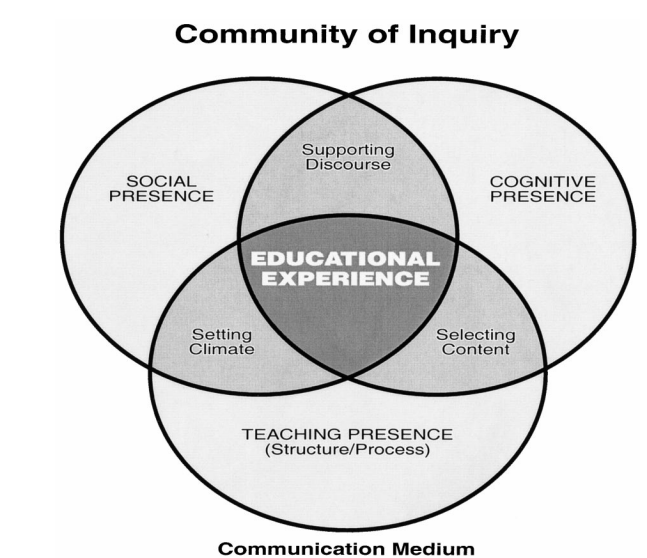
This article introduces the Community of Inquiry (CoI) model, which includes three main elements essential for effective online learning: cognitive presence, social presence, and teaching presence. Cognitive presence refers to learners’ ability to construct and confirm meaning through reflection and communication. Social presence involves creating a sense of community where learners feel connected. Teaching presence is the role of the instructor in designing, facilitating, and guiding the learning process. These three elements work together to foster deep and meaningful learning experiences.
Evaluation
The CoI framework is a valuable tool for educators looking to enhance online learning environments. By focusing on cognitive, social, and teaching presence, it provides a well-rounded approach to supporting students. However, the paper could benefit from more practical examples of how these concepts can be applied in real-life settings. Additionally, while the theoretical foundation is strong, the absence of specific case studies limits its immediate applicability for practitioners.
Reflection
This article helped me understand the importance of balancing the academic and social aspects of online learning. The CoI model offers a clear structure for thinking about how to improve my teaching, especially in fostering social presence, which can sometimes be neglected in online settings. I plan to use this framework to create a more supportive and interactive environment for my students by improving both the social connections and the instructional design of my courses.